

Amatsu in Ireland: Honouring the Past, Healing the Present, Shaping the Future
Amatsu therapy is a holistic healing system rooted in ancient Japanese wisdom and movement science. In Ireland, it has grown into a respected and widely practiced modality thanks to the pioneering work of Dennis Bartram, William Doolan, and many other great teachers. Their vision, dedication, and leadership have helped establish Ireland as one of the global centres for Amatsu training and practice—where tradition meets innovation, and healing is approached with integrity, compassion, and skill.
Ancient Origins: The Amatsu Tatara Legacy
Amatsu therapy traces its lineage to the Amatsu Tatara, sacred scrolls believed to contain divine teachings on medicine (Ryoho), martial arts (Bumon), and spiritual philosophy (Shumon). These teachings were preserved for centuries within the Hichi Buku Goshin Jutsu Ryu, a Japanese school focused on protecting the body, mind, and spirit through movement, breathwork, and energetic awareness.
For over 1,000 years, Amatsu remained a closely guarded tradition in Japan, passed down through oral transmission and encoded teachings. Its principles are deeply rooted in nature, rhythm, and the interconnectedness of all systems within the human body.
A Historic Transmission to the West
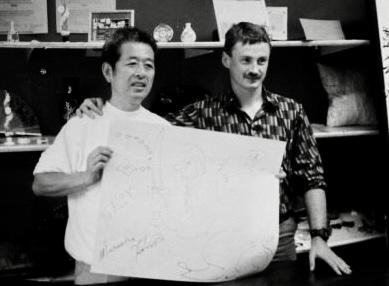
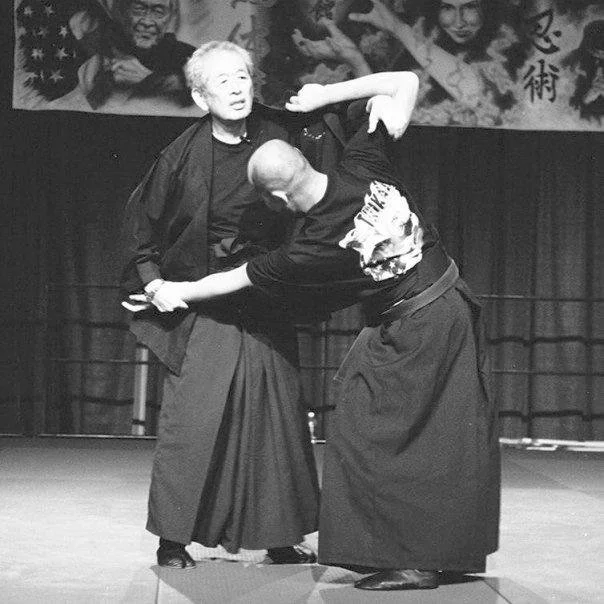
In the 1990s, Dr. Masaaki Hatsumi, Grandmaster of Togakure Ryu and custodian of the Amatsu Tatara, granted Menkyo Kaiden (full teaching rights) to three Western practitioners: William Doolan, Dennis Bartram, and Christopher Roworth. This marked a historic moment, allowing Amatsu to evolve beyond Japan while preserving its sacred lineage.
William Doolan trained extensively under Dr. Hatsumi and Dennis Bartram and became a master of both the martial and therapeutic aspects of Amatsu. His deep understanding of movement, breath, and body mechanics enabled him to adapt the tradition for Western clients while honouring its spiritual and philosophical roots. He was the first person to bring Amatsu back to Ireland and set up a clinic in 1989.
He founded one of the few Amatsu Teaching Centres outside Japan, delivering practitioner and master-level training that has elevated the standard of care across Ireland. To support and unify the growing community of practitioners, he helped to establish the Amatsu Association of Ireland, providing governance, representation, professional training, and a shared ethical framework.
Amatsu training programmes are formally recognised by the Federation of Irish Complementary Therapy Associations (FICTA) and other professional bodies, ensuring rigorous standards of ethics, safety, and clinical excellence.
Today, Ireland hosts a thriving community of Amatsu therapists, many of whom were trained directly by Doolan or through his lineage. His influence is evident in the quality of care, the depth of practitioner knowledge, and the integration of Amatsu into mainstream complementary health.
Healing Philosophy in Irish Practice
Amatsu therapy in Ireland is known for its gentle, non-invasive techniques that treat the body holistically. It addresses five interconnected systems—physical, mental, electrical, chemical, and environmental—using movement-based diagnostics and soft tissue mobilisations to restore balance and vitality.
Irish practitioners work with clients of all ages and conditions, supporting recovery from injury, chronic pain, stress, and postural imbalance. Many are now covered by health insurance providers, making Amatsu more accessible to the public.
A Living Tradition: The Future of Amatsu in Ireland
The future of Amatsu in Ireland is bright. With growing public awareness, expanding training programmes, and increasing integration into multidisciplinary care, Amatsu continues to evolve while staying true to its roots.
New generations of therapists are emerging—grounded in tradition, guided by science, and committed to ethical, client-centred care. William Doolan’s legacy lives on in today’s practitioners who honour the lineage, every client who finds relief, and every movement that restores balance.
Ireland remains a global leader in Amatsu therapy, where ancient wisdom meets modern healing—and where the journey of wellbeing continues.
The Amatsu Technique
Techniques used in Amatsu are designed to achieve balance in the body and to free blockages which can be the source of illness. They are called Anma, Seitai, Shindenjutsu and Kenkujutsu.
-
This literally means ‘to push and pull’. Specific areas of the body are pushed and pulled (gently) to release tension and tightness, thereby restoring the normal flow of blood and lymph to promote growth, repair and restoration of normal function. The techniques involved very closely resemble those used in massage, so that Anma may be regarded as a form of remedial massage.
-
This literally means ‘to correct the body’. It focuses on the head (on neck), Hara (spine/pelvis) and the feet to bring about symmetry and paralateral movement. Therefore all treatments re- align and re-balance the person from head to toe, whilst balancing the meridian circuits of the body and the intrinsic cranio-sacral system. This results in a restoration of symmetry and a boost to homeostasis (immune system) with a reduction of body strains. Seitai is the aspect of Amatsu medicine which most closely resembles Western osteopathy, although in practice, it tends to be much more gentle.
-
This means to find the pivot (fulcrum) and fluid drive through it. In simple terms, it involves the correction of ligament imbalances of the joints and organs of the body. It is the heart of Amatsu balancing. In this approach, the ligaments are employed to spring tensions that have become locked into body structures blocking the flow of energy. Old strains leave a footprint of the injury or illness that continues to malfunction for many years. These archaic patterns lay the foundation for many illnesses we encounter, especially when our immune systems are lowered due to stress. It is precisely these patterns that this method addresses.
-
This literally means ‘the head (and spine)’. It is the name given to Amatsu’ s approach to balancing the cranial mechanism of the head and spine. It is an integral part of the therapy. The head governs all spinal movement (where the head goes, the body follows), and according to Western research, cranial imbalances affect our emotions, posture, dentition, movement, and can cause colic, restlessness and discomfort in newborn babies. Cranial balancing has been found to be useful in the treatment of these as well as many other symptoms. Clinical evidence has shown that it is also beneficial to the treatment of arthritis, tension, dyslexia, sinusitis, pain in pregnancy, concentration, eye strain, headaches, and migraines.
These four areas of Amatsu therapy are not kept separate, and blend into each other during treatment. For example, points on a limb may be stimulated (Anma), whilst the limb is gently moved for positional release (Seitai). This is a gentle therapy, suitable for young and old alike. There are no hard adjustments in Amatsu, and the majority of clients find the treatment to be very relaxing.